
NYC’s Top Criminal Lawyer
NYC Violent Crime Lawyer
Violent Crime Attorney in New York City
In any criminal accusations involving violence, the potential consequences are often far more severe under NY law. In addition to the prison time you might face if convicted, there is a stigma around violent crimes that can haunt a person as they look for jobs, apartments, or apply for college or graduate programs. That’s why you need an experienced NYC violent crime lawyer in your corner.
At Greco Neyland, PC, our team is standing ready to dig up flaws in the prosecutor’s case and seek charges to be reduced or dismissed.
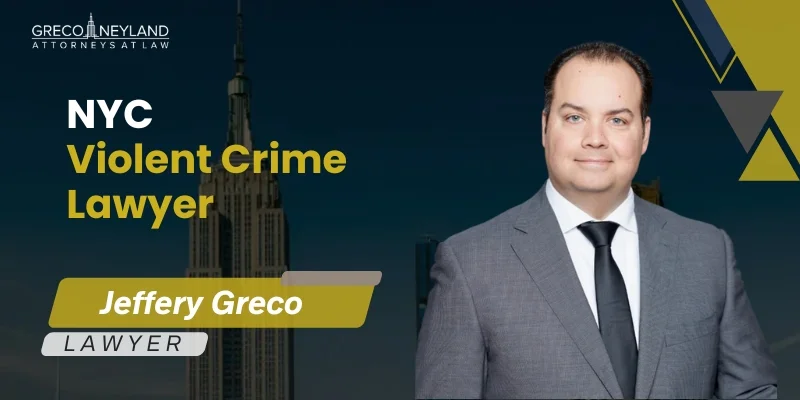
NYC Violent Crime Lawyer
With such serious charges in New York City, don’t leave your future up to chance. We can provide the one-on-one attention necessary for creating the optimal strategy. A skilled NYC violent crime lawyer from Greco Neyland, PC will fight for your rights.
Contact a NYC violent crime lawyer with experience as a former prosecutor at (646) 293-0905 today to set up a free consultation.
We serve clients throughout Manhattan and Brooklyn, as well as all other boroughs.
We Can Help Fight Your Criminal Charges
Understanding Violent Felony Offenses in New York
In New York, a violent felony offense is any crime specifically listed under Penal Law §70.02 that carries a fixed prison term and mandatory post-release supervision (PRS). PRS ensures individuals remain under supervision after release to support reintegration and to also protect the safety of the public. Violent crime laws categorize felonies by class, each with its own sentencing range. Some common violent felony charges include:
- Robbery (Art. 160). First and second-degree robbery are violent felonies; third-degree robbery is not.
- Burglary (Art. 140). Burglary becomes a violent felony when a person is present inside the premises at the time of the offense.
- Strangulation/obstruction of breathing (Penal Law 121.12). This involves intentionally choking someone.
- Weapons possession (Penal Law 265.03). This can be elevated to a violent felony if the weapon is used to threaten or injure another person.
The severity of a violent felony in New York determines its sentencing range, and the law classifies offenses from Class B through Class E, with each class carrying a specific prison term and mandatory post-release supervision. The penalties for each class are as follows:
- Class B: 5–25 years
- Class C: 3½–15 years
- Class D: 2–7 years
- Class E: 1½–4 years
Violent crime cases are bail-eligible, but the judge could set high bail or release conditions. In addition, judges often issue orders of protection under CPL 530.12 and 530.13 to prevent contact between parties. In NYC, bail decisions follow recent reform guidelines that emphasize the alleged offender’s risk, as opposed to their ability to pay.
At Greco Neyland, PC, our experienced attorneys provide clear guidance and aggressive representation for clients charged with violent felonies. We can help protect your rights while you navigate New York’s complicated criminal justice system.
Assault Offenses
One of the most common offenses involving violence is assault. Assault charges, under New York law, can range from misdemeanors (assault 3) to felonies. However, they should all be taken very seriously. Assault charges under New York Penal Law §§ 120.00-12 involve some kind of injury to a person caused intentionally, recklessly, or with criminal negligence by the accused.
Charges may escalate depending on the alleged intent of the accused, the seriousness of the injury, whether a deadly weapon was used, and the victim. For instance, charges are more serious if the victim was a:
- Police officer
- Firefighter
- Emergency Medical Technician (EMT)
- Child
When more than one person is accused, the group may face charges of gang assault. In assault cases, an experienced NYC violent crime lawyer can determine if the circumstances of your case meet the criteria for a self-defense argument, Penal Law 35.15. If there was reason to believe that you would be put in imminent harm if you hadn’t acted, your use of force could have been justified.
Other Charges Involving Violence Under Article 120 Of New York Penal Law
Menacing (New York Penal Law §§ 120.13-15, 120.18)
Menacing means to put a person in fear of death or injury. There are three degrees of menacing, ranging from misdemeanors to felonies. Charges become worse if they involve a weapon, certain behavior like following the victim, violating a protective order, or a prior conviction for the same offense.
Menacing a police officer is a separate offense.
Stalking (New York Penal Law §§ 120.45-60)
Stalking charges involve engaging in conduct that puts a person in reasonable fear for their physical health, actual harm to their mental or psychological health, or fear about their job. To be convicted, the accused must be clearly told to stop their conduct, and instead, they keep doing the same thing.
There are four degrees of stalking. Causing physical injury or any type of sexual contact can escalate charges to a class D felony.
Reckless Endangerment (New York Penal Law §§ 120.20-25)
Reckless endangerment means creating the risk of serious injury or death for another. You do not have to intend to hurt anyone by your actions, nor must someone be hurt, for prosecutors to secure a conviction.
Kidnapping And Unlawful Imprisonment
New York Penal Law § 135.00 differentiates between restraining a person and abducting a person. The difference between the two is critical because one constitutes the very serious charge of kidnapping, a class A-I felony, and the other constitutes unlawful imprisonment, which, while serious, does not carry the same level of punishment.
To restrain a person means to unlawfully restrict a person’s movements without his or her consent and move that person from one place to another or confine that person to a certain space. A person who restrains another person under this definition is guilty of unlawful imprisonment, which may be a class A misdemeanor or a class E felony.
To abduct a person means to hold a person in a place where he or she is unlikely to be found, or to use or threaten to use deadly force to restrain a person. Kidnapping charges involve abducting a person and can range from a class B felony to a class A-I felony.
Coercion is, similarly, a criminal charge involving restraining another’s liberties under Article 135 of New York Penal Law. Coercion means to force a person to do something or prevent them from doing something by placing that person in fear of physical injury, property damage, or other methods outlined in the law.
Homicide
There are many different charges that a person might face under Article 125 of Penal Law if he or she is accused of being criminally responsible for the death of another person. The key difference in these charges, for the most part, is the alleged intent of the person accused.
Criminally negligent homicide means that the accused failed to act as a reasonable person to a criminal degree, and a person’s death resulted.
Manslaughter is a broader term for several offenses in which the accused’s actions were not intended to kill the victim. They can range from reckless actions to actions that were intended to kill one person but killed another by mistake.
Murder is a Class A-I felony, the most serious offense in New York law. In murder charges, the defendant is accused of killing a person with the intent to do so. Most charges are for second-degree murder. However, one of several aggravating factors can cause the charges to escalate to first-degree murder.
Hire a Violent Crime Lawyer
Like any other element of a crime, the District Attorney must bring sufficient proof to prove intent beyond a reasonable doubt. The failure to prove intent can mean the difference between manslaughter and murder charges, and therefore decades of prison. Our NYC violent crime lawyers can challenge any evidence the prosecutor attempts to bring forward in your violent crime case.
FAQs
Q: How Are Domestic Violence Cases Handled In New York?
A: In New York, domestic violence cases are treated seriously, and they can involve criminal charges, protective orders, and mandatory court appearances. Law enforcement might arrest the alleged offender immediately, and victims can seek an order of protection. Cases are typically prosecuted by the district attorney’s office, and outcomes can include fines, probation, or imprisonment.
Q: How Are Violent Crimes Counted?
A: Violent crimes are generally counted based on reports made to law enforcement and the classification of the offense under New York law. These crimes include acts like assault, robbery, homicide, and sexual assault. Each reported incident is logged and could involve multiple charges if more than one act occurred. Accurate documentation is important for prosecution, sentencing, and statistical tracking.
Q: How Long Do You Have to Report a Crime In NY?
A: The length of time you must report a crime in New York varies depending on the type of offense. Some crimes, like felonies, might have a longer or no statute of limitations, while misdemeanors typically must be reported sooner. Immediate reporting is recommended for violent crime cases to preserve evidence and witness testimony. Our team can help you understand deadlines and protect your legal rights.
Q: What Falls Under Violent Crime?
A: Violent crime in New York includes offenses where physical harm or the threat of harm is involved. Common examples are assault, robbery, murder, manslaughter, and sexual assault. Certain hate crimes or domestic violence cases can also be classified as violent crimes depending on the circumstances. These crimes are prosecuted aggressively due to their serious nature. Our team can help navigate both criminal and civil consequences.
NYC Violent Crime Lawyer
Any offense that involves accusations of violence could mean very serious penalties. It is wise to have a skilled criminal defense attorney on your side. Contact a Manhattan violent offense lawyer at Greco Neyland, PC. Call (646) 293-0905 for a free consultation.
New York Violent Crime Law Resources
Greco Neyland Attorneys At Law
Call Us Today 212-951-1300
-
Midtown (Main Office)
Location: 1140 Avenue of the AmericasSuite 1035 (10th Floor)
New York, NY 10036
Phone: (212) 951-1300
-
White Plains Location:
75 S Broadway, 4th Floor
White Plains, NY 10601Phone: 914-295-9000
-
Long Island Location:
6800 Jericho Tpke.
Suite 108W-1
Syosset, NY 11791 -
24 Hour Service
& Free Consultations
Available
© 2026 Greco Neyland, PC - NYC Criminal Defense Lawyer. All rights reserved
*Images are obtained under license from Canva and other third-party stock image providers, with attribution included where required.
Digital Marketing By 
 ES
ES